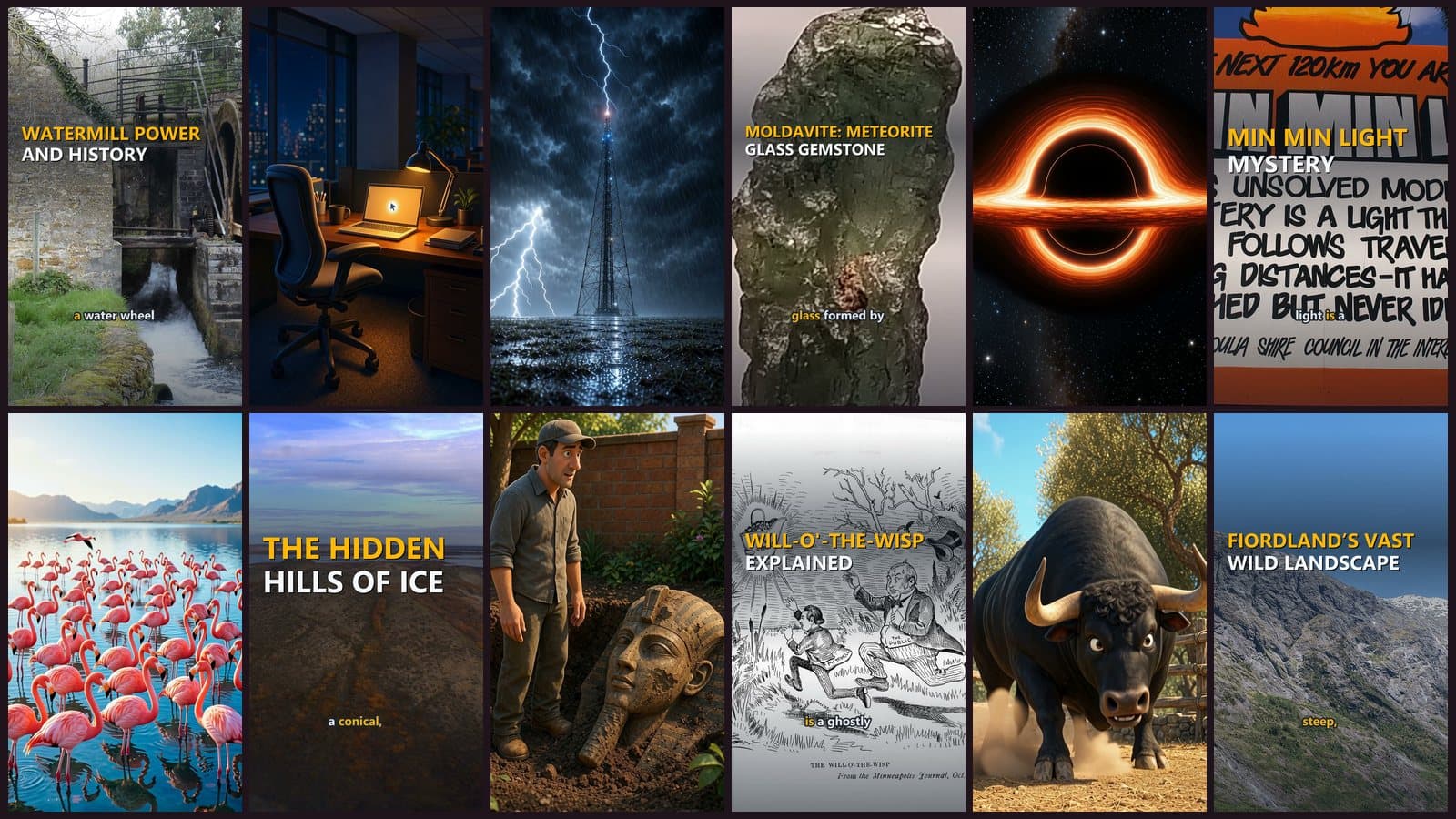
Culturix makes short videos about the world, published as Kulcha: places, history, science, nature and culture, told with a sense of humour and built from sources you can check. This post explains why we work that way. In one sentence: we think a feed can be fun and good for you at the same time, and that curated, source-linked short videos are one practical way to get there.
The problem: the feed rewards what spreads, not what is true
Short-form video is now where many people first meet a fact about the world. That is a huge opportunity, and a real risk. Feeds are tuned for attention, and attention does not check sources. A large study of news on Twitter found that false stories travelled farther, faster and more widely than true ones, largely because they were more novel and more surprising (Vosoughi, Roy and Aral, Science, 2018).
We take the lesson the other way round. Surprise is not the enemy. Most true things about the world are astonishing once you look closely: a mountain that is still growing, a continent of ice that is technically a desert, a myth everyone repeats that turns out to be wrong. If true stories are told with the same energy as false ones, they can compete for attention. That is the bet behind Kulcha.
What curated content means to us
Curation is a choice about what deserves people's time. For us it comes down to four commitments.
1. Every video starts from a source
A video begins with a trusted source, not with an idea we want to be true. That source can be an encyclopedia article, a UNESCO World Heritage listing, a space agency, a geological survey, a museum, a scientific journal or a reputable publisher. One good source is enough when it covers the story well, and it does not have to be Wikipedia. The facts in the script come from that source, and the source is linked so anyone can read the full story.
2. Checks before anything goes out
Before a video is published, automatic checks compare it with its source: are the numbers in the source and said correctly, does each claim match what the source says, does each picture show what the sentence describes, is anything sensitive. Anything those checks flag waits for a person to look at it, with the reason written in plain words. A video that cannot be fixed is not published.
3. Humour that serves the fact
Jokes are how we hold attention, never how we bend the facts. In Not So Fast, three animal hosts take apart a popular misconception, and the correction comes from the cited source. In Kulcha Toons, a recurring cast reacts to moments people around the world are talking about. In World, each video tells the story behind one place, discovery or tradition. The comedy is ours; the facts belong to the source.
4. Honest about how it is made
Our videos are animated with AI tools, and we say so. The pictures in explainers are credited to their photographers and archives, and the source of each video is named. Being open about how a video is made is part of being trustworthy: people should know what they are watching.
Why a world view, and why it matters for healthy information sharing
Much of what goes viral is local, angry or both. We look for the opposite: subjects that people in many countries can enjoy and share without taking sides, such as natural wonders, scientific surprises, the origins of foods and festivals, and the history behind famous places. A good fact is a gift you can pass on. When someone shares a short video that is true, sourced and kind, they make their own corner of the feed a little healthier.
That is also why the site works by place. You can open the World map, pick a country and watch what we have made about it, from a volcano to a dish to a centuries-old craft. The site is available in English, French, German and Spanish, and transcripts can be read in your language.
How to judge any short video, ours included
Curation only helps if viewers stay curious. Four quick habits work on any platform:
- Look for the source. A claim with no named source is an opinion until proven otherwise.
- Check the number. Big, precise numbers are easy to invent and easy to verify; search for them.
- Notice the feeling. If a video makes you angry or smug within seconds, pause before sharing.
- Prefer the original. Follow the link to the article, museum or agency rather than a copy of a copy.
Questions people ask us
What is Kulcha?
Kulcha is the channel name for Culturix's short videos: an AI-animated, source-linked video encyclopedia of the world with a sense of humour, in three series (World, Not So Fast and Kulcha Toons), free to watch on this site and on social media.
Where do the facts come from?
From the source each video names: for example Wikipedia, UNESCO, NASA, NOAA, the US Geological Survey, the British Geological Survey, museums and peer-reviewed journals. Every video page links its source.
Are the videos made with AI?
Yes. The animation and voices are made with AI tools. The facts come from the cited source and are checked against it before a video is published.
Where can I watch?
On culturixcloud.com/world, and on YouTube, TikTok and Instagram. If a fact in one of our videos looks wrong to you, the comments under each video on this site are the best place to tell us.
Our promise
We will keep choosing stories that are worth your minute, keep showing where every fact comes from, and keep the jokes on our side of the line. If the time you spend with Kulcha leaves you knowing something true about the world that you did not know before, the feed did its job.